

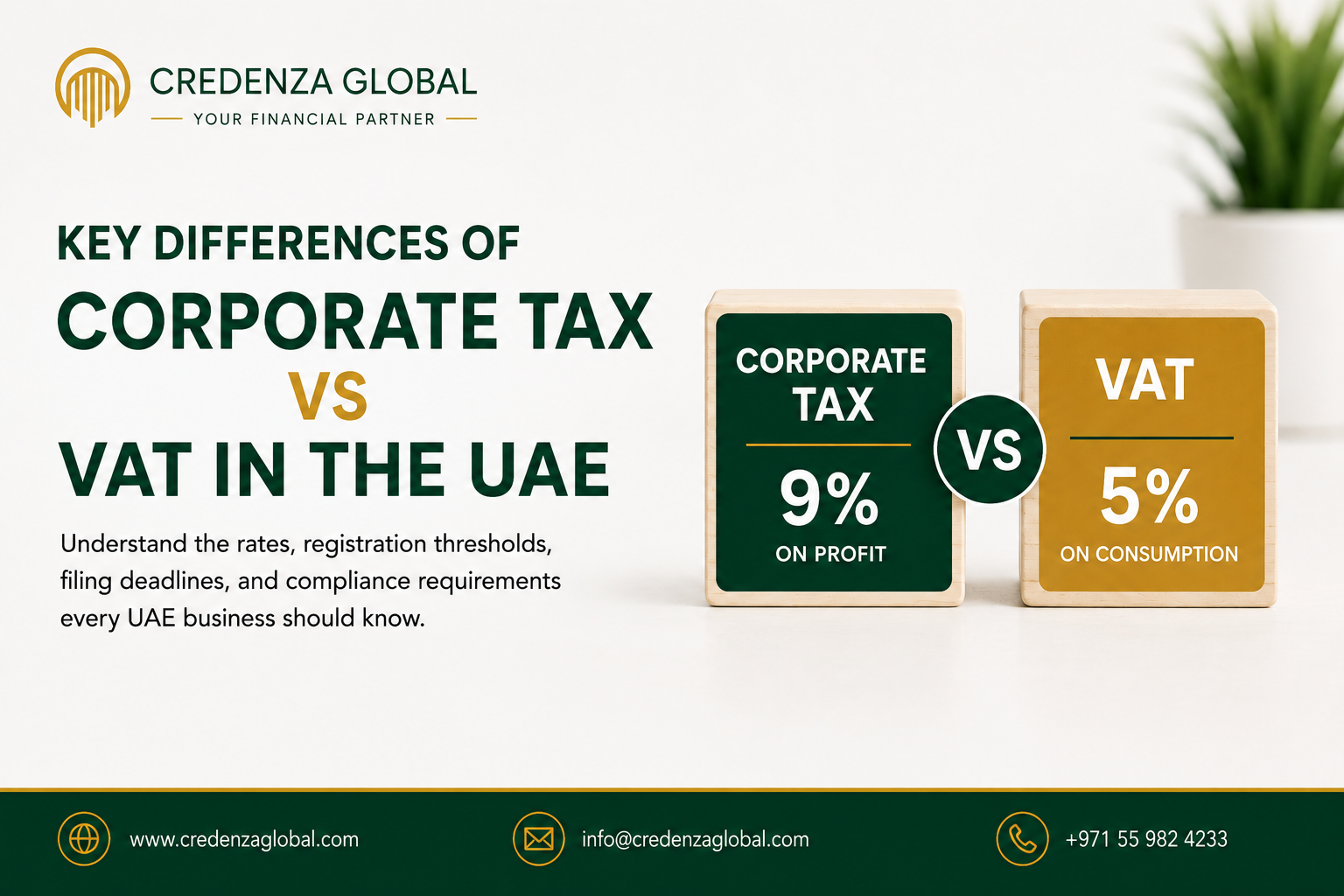
If you run a business in the UAE, you’ve almost certainly come across two terms that get mixed up more often than they should: Corporate Tax and VAT (Value Added Tax). Both are administered by the Federal Tax Authority (FTA), both carry real penalties for non-compliance, and both apply to a wide range of businesses, but these are fundamentally different taxes, with different rates, different triggers, and different filing calendars.
At Credenza Global Accounting & Bookkeeping LLC, we work with startups, SMEs, and growing businesses across Dubai and the wider UAE to help them stay compliant with both regimes without the guesswork. In this guide, we break down exactly how Corporate Tax and VAT differ, who needs to register for each, and how to avoid the penalties that catch so many businesses off guard.
What Is Corporate Tax in the UAE?
Corporate Tax is a direct tax on the net profit (taxable income) of a business. It was introduced under Federal Decree-Law No. 47 of 2022 and has applied to financial years starting on or after 1 June 2023.
Key facts about UAE Corporate Tax:
• Standard rate: 9% on taxable income above AED 375,000
• Zero-rate band: 0% on taxable income up to AED 375,000
• Small Business Relief: Eligible resident businesses with revenue of AED 3 million or less can elect to be treated as having no taxable income (effectively 0% tax), for tax
periods ending on or before 31 December 2026
• Free Zone businesses: May qualify for a 0% rate on “qualifying income” under the Qualifying Free Zone Person (QFZP) regime, subject to strict conditions
• Large multinationals: Groups with global consolidated revenue above roughly EUR 750 million fall under a separate 15% Domestic Minimum Top-up Tax (DMTT)
• Filing deadline: Corporate Tax returns are due 9 months after the end of the relevant financial year (e.g., a business with a 31 December year-end must file and pay by 30
September of the following year)
Almost every business operating in the UAE, mainland or free zone must register for Corporate Tax with the FTA, even if it ultimately owes nothing. Registration is mandatory; the zero-rate band and Small Business Relief are tax bands and elections, not exemptions from registration.
What Is VAT in the UAE?
VAT is an indirect tax on the consumption of goods and services, introduced across the UAE on 1 January 2018. Unlike Corporate Tax, which is based on annual profit, VAT is charged transaction by transaction and collected by businesses on behalf of the government.
Key facts about UAE VAT:
• Standard rate: 5% on most goods and services
• Mandatory registration threshold: AED 375,000 in taxable supplies and imports over the previous 12 months (or expected in the next 30 days)
• Voluntary registration threshold: AED 187,500
• Zero-rated and exempt supplies: Certain sectors (e.g., healthcare, education, exports, some financial services) are zero-rated or exempt
• Filing frequency: Typically quarterly, though some businesses file monthly depending on their FTA registration
• Payment: VAT collected from customers (output VAT) minus VAT paid on business expenses (input VAT) is remitted to the FTA
VAT registration is based on turnover, not profit — so even a business operating at a loss can be required to register and file VAT returns.
Corporate Tax vs VAT: Side-by-Side Comparison
Feature |
Corporate Tax |
VAT |
|---|---|---|
| Type of tax | Direct tax on profit | Indirect tax on consumption |
| Introduced | 1 June 2023 | 1 January 2018 |
| Standard rate | 9% (above AED 375,000 profit) | 5% |
| What triggers registration | Holding a trade license / earning taxable income | Turnover crossing AED 375,000 (mandatory) |
| Filing frequency | Annually | Usually quarterly |
| Filing deadline | 9 months after financial year-end | 28 days after each tax period ends |
| Who bears the cost | The business, on its own profit | The end consumer; business collects and remits |
| Small Business Relief | Available (revenue ≤ AED 3 million, until 31 Dec 2026) | Not applicable |
| Governing law | Federal Decree-Law No. 47 of 2022 | Federal Decree-Law No. 8 of 2017 |
Why Businesses Confuse the Two
Most confusion comes from three areas:
1. “We’re too small to worry about tax.” Many small businesses assume that because they qualify for 0% Corporate Tax or fall under Small Business Relief, they don’t need to register at all. In reality, registration is still mandatory for Corporate Tax, and VAT registration depends purely on turnover, not profitability.
2. Mixing up deadlines. Corporate Tax is filed once a year; VAT is usually filed every quarter. Businesses that track only one calendar often miss the other.
3. Assuming free zone status means no tax. Free zone businesses can still owe Corporate Tax on non-qualifying income and are generally required to register for and charge VAT like any other business, unless a specific exemption applies.
How Credenza Global Helps
Managing two separate tax regimes with different rates, thresholds, and filing cycles, is exactly where most SMEs lose time and risk penalties. Credenza Global Accounting & Bookkeeping LLC supports businesses across the UAE with:
• Corporate Tax registration, return filing, and Small Business Relief elections
• VAT registration, return filing, and reconciliation
• Bookkeeping that keeps your records audit-ready year-round
• Penalty risk reviews so nothing slips through the cracks
• Ongoing financial consulting to help you plan around both tax obligations
Whether you’re a startup registering for the first time or an established SME trying to stay compliant across both regimes, our team keeps your filings accurate, timely, and cost-effective.
Frequently Asked Questions
Q1. Can a business be required to pay both Corporate Tax and VAT?
Yes. They are separate taxes with separate registration requirements. A business can be liable for VAT on its turnover and Corporate Tax on its profit at the same time.
Q2. Do I need to register for Corporate Tax if my profit is below AED 375,000?
Yes. The AED 375,000 threshold is a 0% tax band, not an exemption from registration. Businesses must still register with the FTA and file returns.
Q3. Does Small Business Relief remove my VAT obligations too?
No. Small Business Relief applies only to Corporate Tax. If your turnover crosses the AED 375,000 VAT threshold, you must still register for and file VAT regardless of your Corporate Tax position.
Q4. What happens if I miss a filing deadline?
Late registration, late filing, and late payment for both Corporate Tax and VAT carry separate administrative penalties under FTA regulations. Penalties can apply per violation and accumulate quickly if left unaddressed.
Q5. Are free zone companies exempt from Corporate Tax and VAT?
Not automatically. Free zone businesses may qualify for a 0% Corporate Tax rate on qualifying income under the QFZP regime.
Q6. How often do I need to file VAT returns?
Most businesses file VAT returns quarterly, though the FTA may assign monthly filing to some businesses based on turnover or risk profile. Your FTA registration certificate specifies your filing period.