

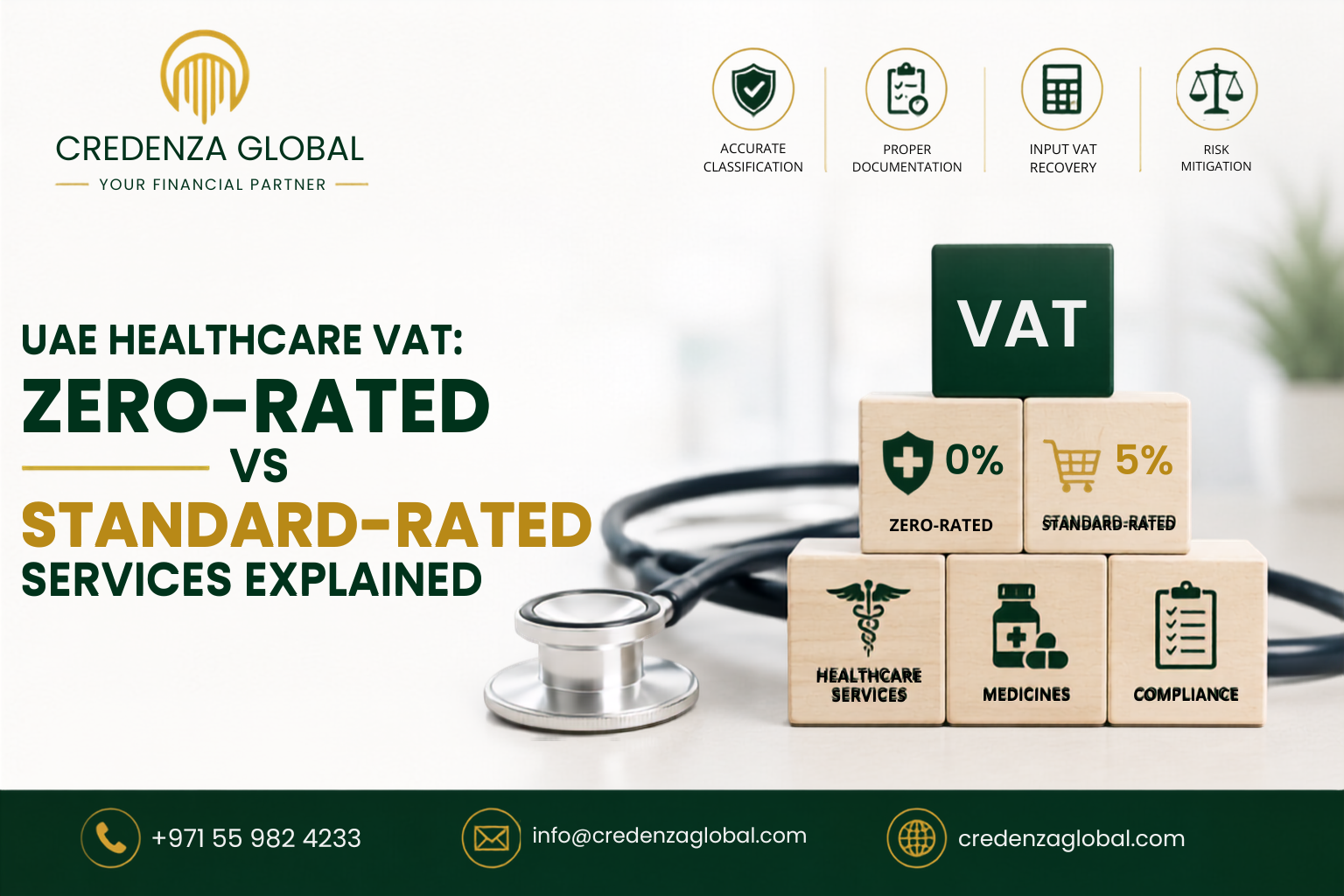
If you run a clinic, hospital, or medical practice in the UAE, VAT on healthcare isn’t as simple as “medical equals tax-free.” A single patient visit can involve two or three different VAT treatments depending on exactly what was provided, and getting the classification wrong is one of the most common and costly compliance mistakes in the sector.
First, a Clarification Worth Knowing
Most people default to calling this “exempt vs. taxable,” but that’s not quite how UAE VAT law treats healthcare. In the UAE, healthcare services fall into two categories: zero-rated at 0 percent, or standard-rated at 5 percent. There is effectively no VAT exemption category for healthcare, unlike sectors such as certain financial services or residential property.
This distinction matters more than it sounds. Zero-rated supplies are still part of the VAT system. Providers charge 0 percent but can still recover input VAT on related costs like equipment, supplies, and building expenses. A genuinely exempt supply, by contrast, would block input VAT recovery entirely. Getting this terminology right affects how you structure your VAT return and how much input tax you can legitimately reclaim.
What Qualifies as Zero-Rated Healthcare
Preventive and curative healthcare services provided by facilities licensed by the relevant UAE health authority are generally zero-rated. This typically includes medically necessary consultations, diagnoses, and treatments, preventive healthcare services and approved medicines, therapeutic dental treatment such as fillings, root canals, and medically necessary orthodontics, ward accommodation for patients, and administration fees charged in connection with a zero-rated healthcare service.
The key phrase throughout is medically necessary. If a service is provided to diagnose, treat, or prevent a genuine health condition, it generally qualifies for zero-rating.
What’s Standard-Rated at 5 Percent, and Where Providers Get Tripped Up
This is where most classification errors happen. Services that are elective, cosmetic, or not clinically necessary are standard-rated at 5 percent, even when performed in a medical setting by a licensed professional. Common examples include cosmetic procedures like Botox, dermal fillers, and aesthetic rhinoplasty with no clinical basis, elective cosmetic surgery such as facelifts and liposuction for aesthetic reasons, teeth whitening and purely cosmetic veneers, cosmetic hair transplants, diagnostic services like blood tests, scans, and imaging in many cases, accommodation for non-patients such as relatives or companions staying alongside a patient, retail health products, vitamins, and supplements not on the FTA-approved medicines list, and most pharmacist-provided services aside from approved medicines themselves.
The Same Procedure, Two Different VAT Outcomes
The clearest way to understand this system is through a single example that appears across most FTA-aligned guidance: rhinoplasty. If the procedure corrects a breathing impairment, it’s zero-rated, since it’s medically necessary. The exact same surgical procedure performed purely for aesthetic reasons is subject to 5 percent VAT. The physical procedure doesn’t determine the VAT treatment. The clinical justification does.
This is why documentation matters so much in healthcare VAT compliance. If the FTA ever queries a classification, providers need clinical records that support why a service was treated as zero-rated, not just an invoice that says so. Solid accounting and bookkeeping practices make this kind of documentation and compliance process easier to manage.
Medicines Are Not All Automatically Zero-Rated
Prescription medicines are usually zero-rated, but non-prescription or lifestyle-related products often fall under the standard 5 percent rate. Pharmacies in particular face an ongoing challenge here, since the list of approved medicines is maintained and periodically updated by the Ministry of Health and Prevention. A product that qualified last year may not automatically still qualify, and new products need to be checked against the current list before being invoiced as zero-rated.
For Mixed Providers, Why Input VAT Apportionment Gets Complicated
Most hospitals and larger clinics don’t provide exclusively zero-rated or exclusively standard-rated services. They provide both. A hospital offering general medicine, which is zero-rated, alongside a cosmetic dermatology department, which is standard-rated, has to apportion its input VAT recovery accordingly. Direct costs, meaning expenses clearly attributable to one type of service, are recovered in full or not at all depending on which category they relate to. Shared costs such as building, administration, and management overhead need to be apportioned on a pro-rata basis, typically based on the ratio of standard-rated to total turnover.
Because healthcare providers are frequently in a position where the majority of their supplies are zero-rated, they can often recover substantial input VAT on equipment, construction, IT systems, and utilities, which can result in a net VAT repayment position rather than a liability. That’s a meaningful cash flow consideration, but it also means healthcare VAT returns tend to draw closer FTA scrutiny than a typical standard-rated business. Providers should also consider these requirements alongside their broader taxation obligations
The Most Common Mistake
By far the most frequent compliance issue in this sector is misclassifying an elective procedure as preventive healthcare to avoid charging the patient VAT. A cataract surgery performed on a healthy adult purely by preference, for instance, is not the same as one performed out of medical necessity, and the FTA assesses this based on clinical records, not just how the invoice was labeled. Providers found to have consistently misclassified services face not just penalties, but the risk of having historical returns reassessed.
Practical Steps for Healthcare Providers
Classify at the service level, not the department level, since a single clinic can have both zero-rated and standard-rated line items. Maintain clinical documentation that supports the medical necessity of each zero-rated service. Cross-check medicines against the current MoHAP-approved list before invoicing, rather than relying on last year’s classification. Apportion input VAT correctly if you provide a mix of zero-rated and standard-rated services. Review VAT treatment periodically, since regulatory guidance and approved lists change, and a classification that was correct at registration may need revisiting.
Getting the Classification Right From the Start
Healthcare VAT in the UAE isn’t a single flat rule. It’s a service-by-service, sometimes patient-by-patient, determination. Providers that build proper classification and documentation processes early tend to avoid both overcharging patients unnecessarily and underreporting VAT liability, either of which creates real risk during an FTA review Credenza Global provides VAT advisory to help healthcare businesses manage VAT requirements, alongside broader taxation and accounting and bookkeeping services