

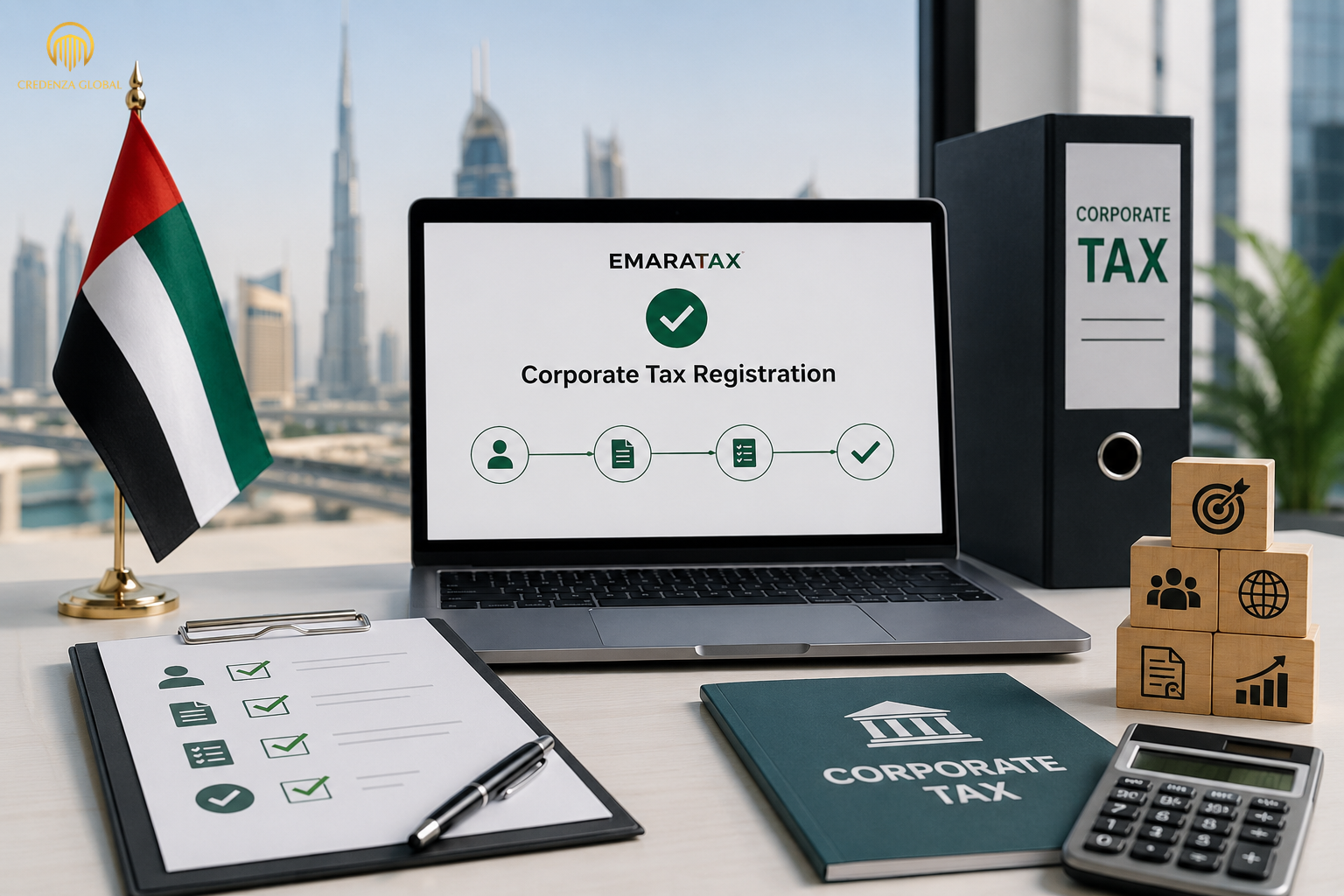
If you run a business in the UAE, you will need to register for Corporate Tax (CT). There is a general understanding that all businesses need to register, even if they do not pay tax, so those that fail to do so face consequences. Here is how to register, who should, and what to do after
Who Needs to Register for Corporate Tax?
Before looking at how to register, let us briefly discuss who needs to. Businesses that are incorporated in the UAE (Free Zone or mainland), companies with branches in the UAE, Free Zone businesses (the ones entitled to the 0% Qualifying Free Zone Person regime are an exception), and non-resident businesses with a permanent establishment in the UAE fall under the CT regime. This might be surprising to some, but businesses in the UAE’s Free Trade Zones are still required to register for CT. The 0% tax rate is not extended to registering for the CT.
How to Register for Corporate Tax: Step-by-Step Guide
Registering is a fairly simple process that requires several steps:
1. Sign in to your EmaraTax account The registration process is done online, so you will have to sign up for an account (if you do not have an EmaraTax account). If the business already has a VAT registration, the same EmaraTax account may be used to register for CT as well.
2. Provide the necessary documents Before we discuss how to register for CT via EmaraTax, one must know what to prepare to register. The following documents will need to be provided:
- A copy of your trade license
- The passport and Emirates ID of the signatory
- The Memorandum of Association (MoA) or similar statutory documents
- The contact information of the business and the financial year-end date
3. Fill out the registration form Next, you will need to fill out the form providing the details about the business activity undertaken by the company, its legal structure, and financial year-end date (determines filing date).
4. Submit an application and wait for approval Upon submission, the applicant will receive the Corporate Tax number. It is different from a VAT taxpayer reference number (TRN) if the business has one. Once you receive it, remember to store it safely because you will need it for all CT communications with the FTA.
5. After registration, note the filing deadline of the Corporate Tax return, which is due 9 months after the end of the financial year. If your business’s year-end is 31 December, you may expect the filing due date to be 30 September of the following year.
Common Errors to Avoid
When filing taxes, especially for the first time, businesses tend to make some common mistakes. With respect to registering for CT, there are several common errors:
- Registering late: Businesses that fail to register on time will be subjected to hefty penalties.
- Assuming that being a Free Zone entity means no need to register for CT: This is a common misunderstanding that many businesses in the UAE Free Trade Zones have.
- Providing inconsistent information about business activities: It is vital to ensure consistency between the trade license, VAT registration (if any), and the CT application.
- Failure to register a correct year-end: Remember that the year-end determines the filing due date. It is therefore essential to provide accurate information.
- Failure to understand that registration is just the beginning: Registration is the first step, but there are other steps, such as maintaining proper books of account, ensuring eligibility for reliefs, etc.
What to Do After Registering for Corporate Tax?
After registering for CT, businesses must keep proper books of account throughout the year, identify whether they qualify for any reliefs that reduce their taxable profits, be mindful of the year-end and filing deadline, submit a Corporate Tax return (using the EmraTax portal), and pay the tax due by the due date to avoid additional penalties. Most businesses in the UAE are liable to pay 9% Corporate Tax (on profits over AED 375,000), while profits of AED 375,000 and below are taxed at 0%.
Conclusion
CT registration is relatively simple, but errors creep in, particularly when people overlook the relevant date or fail to consider being eligible for any reliefs. Getting it right the first time around will save businesses headaches when filing their Corporate Tax returns.
Need help with Corporate Tax registration or filing? Credenza Global offers Corporate Tax, taxation & bookkeeping support for UAE businesses