

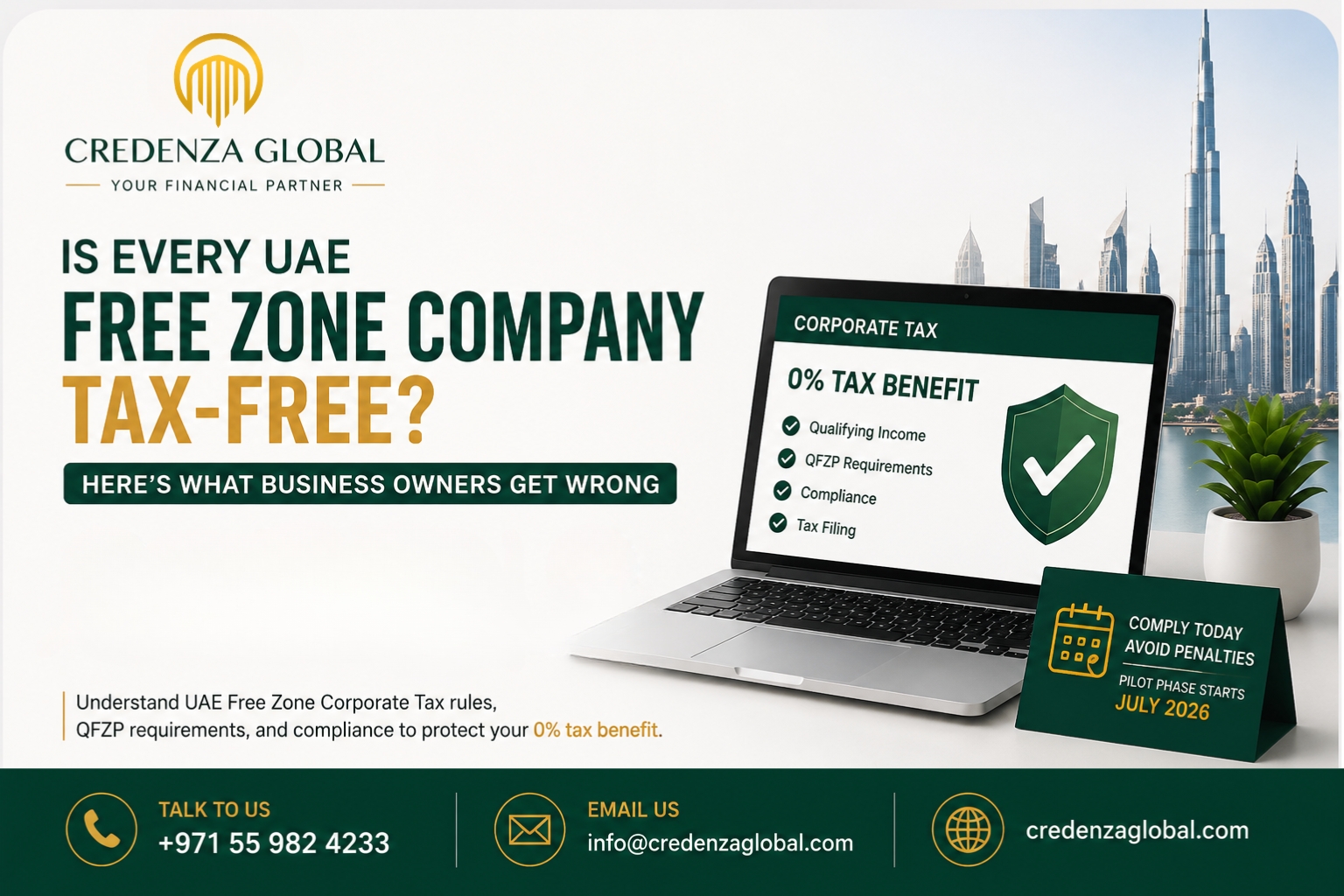
Short answer: No. Setting up in a UAE Free Zone doesn’t automatically hand you a 0% tax rate. One of the most common questions business owners ask is: does a Free Zone company pay corporate tax in the UAE? The reality is more nuanced than most people assume, and it’s one of the biggest misconceptions we see at Credenza Global when advising startups and SMEs on UAE tax-free company rules.
To legally benefit from UAE Free Zone tax exemption, your entity must qualify as a Qualifying Free Zone Person (QFZP) and satisfy specific conditions set out in the UAE’s business taxation framework. Miss these conditions, and your entity could lose its tax incentives entirely — sometimes for several periods in a row.
In this guide, Credenza Global — corporate tax consultants in Dubai — walks you through how Dubai Free Zone corporate tax actually works, how to qualify as a Qualifying Free Zone Person, and what’s needed to stay compliant.
Understanding Corporate Tax for Free Zone Companies in the UAE
Since the rollout of the UAE’s corporate tax regime, all businesses; including those operating from a Free Zone, fall within its scope. A Free Zone license is no longer, on its own, a shield from tax obligations.
That said, eligible entities can still access a 0% rate on Qualifying Income, as long as they meet the full set of legal requirements. Any revenue that doesn’t meet the criteria is taxed at the standard 9% rate under prevailing UAE tax regulations.
In short: your license doesn’t decide your tax outcome by itself. Your eligibility status and the nature of your income do.
How to Qualify as a Qualifying Free Zone Person (QFZP)
A Qualifying Free Zone Person is an entity that meets every condition prescribed under UAE tax regulations. To achieve this status, a business must generally:
- Be incorporated or registered in a recognized zone
- Maintain adequate economic substance in the UAE
- Derive income that meets the qualifying criteria
- Stay within the required de minimis threshold for non-qualifying revenue
- Prepare audited financial statements where required
- Comply with UAE Transfer Pricing regulations
- Maintain proper accounting and bookkeeping records
- Continue satisfying all conditions in every tax period
Missing even one requirement can affect your standing — which is why ongoing compliance matters far more than a one-time setup. This is also where many UAE Corporate Tax registration steps trip up first-time business owners.
Does Every Type of Income Qualify for the 0% Rate?
No. The 0% rate applies only to qualifying revenue, not everything your entity earns.
Income that may qualify includes:
- Transactions with other qualifying entities
- Certain international transactions
- Approved qualifying activities specified under UAE regulations
Income that typically does NOT qualify:
- Certain mainland transactions
- Regulated financial services
- Income from intellectual property in specific cases
- Other excluded activities defined by regulation
Non-qualifying revenue is generally taxed at the standard 9% rate, even if the rest of your operations enjoy preferential treatment — an important factor in any Free Zone company tax calculation in the UAE.
3 Common Myths About UAE Free Zone Tax Benefits — Debunked
❌ Myth 1: “My company is in a Free Zone, so I pay zero tax.” Reality: Location alone doesn’t guarantee tax exemption. You must hold qualifying status and earn eligible income.
❌ Myth 2: “I don’t need to register for corporate tax.” Reality: Most such entities must still complete UAE Corporate Tax registration and file returns — even if they ultimately qualify for the 0% rate.
❌ Myth 3: “I can skip proper accounting since my rate is 0%.” Reality: Accurate bookkeeping and financial records remain mandatory no matter your tax rate. Weak record-keeping can jeopardize your qualifying status altogether.
What Happens If an Entity Fails to Qualify?
If a business fails to meet the QFZP conditions, it risks losing its qualifying status. The consequences can include:
- Loss of preferential tax treatment on eligible income
- Taxation at the standard 9% rate on applicable revenue
- Additional compliance obligations
- Potential loss of qualifying status for multiple future tax periods, depending on the circumstances
This makes proactive compliance far cheaper than reactive damage control down the line.
UAE Corporate Tax Compliance: How These Businesses Can Stay Protected
To safeguard your tax benefits in the UAE, your business should:
- Maintain accurate, up-to-date accounting and bookkeeping records
- Prepare audited financial statements where required
- Regularly review whether income meets the qualifying criteria
- Monitor non-qualifying revenue thresholds
- Comply with Transfer Pricing documentation requirements
- File returns on time to meet UAE Corporate Tax registration obligations
- Seek professional tax advisory services in the UAE whenever business activities change
This is especially relevant for UAE Corporate Tax for startups, where activities and revenue streams often shift quickly in the early growth stages.
Frequently Asked Questions
Does a Free Zone company pay corporate tax in the UAE? It can. Only entities that qualify as a Qualifying Free Zone Person and earn eligible income benefit from the 0% rate. All other revenue may be taxed at 9%.
How do I qualify as a Qualifying Free Zone Person? You need to be incorporated in a recognized zone, maintain economic substance, derive qualifying income, stay within non-qualifying revenue thresholds, and meet ongoing accounting and Transfer Pricing obligations.
Do Free Zone companies still need corporate tax registration? Yes. Most such entities are required to register and file returns under UAE tax regulations, regardless of whether they ultimately qualify for the 0% rate.
What happens if a Free Zone company loses its QFZP status? It becomes subject to the standard 9% rate on applicable income and may lose its qualifying status for multiple future tax periods.
Is bookkeeping still required if my tax rate is 0%? Yes. Accurate financial records and UAE bookkeeping services are mandatory for all such businesses, regardless of their tax rate.
Dubai’s Free Zones still offer genuinely attractive tax incentives — but they are not automatic. To benefit from a 0% rate, your business must satisfy the Qualifying Free Zone Person requirements and ensure its income meets the criteria under the UAE’s tax regime.
Consistent compliance, accurate bookkeeping, and timely filings are essential to preserving these benefits in the UAE and avoiding unnecessary tax exposure.
Need Expert Guidance on Free Zone Tax Rules?
Credenza Global Accounting & Bookkeeping LLC is one of the trusted accounting firms in Dubai, helping startups, SMEs, and growing businesses stay compliant and financially sound. As experienced corporate tax consultants in Dubai, our team supports you with:
- Corporate Tax Registration
- Corporate Tax Return Filing
- Free Zone Tax Assessment
- QFZP Eligibility Review
- Accounting & Bookkeeping
- Financial Statements
- Tax Advisory Services